
By Latifah Ajetunmobi | Parent, Teen & Life Coach | Author of Beyond the Goat Pen
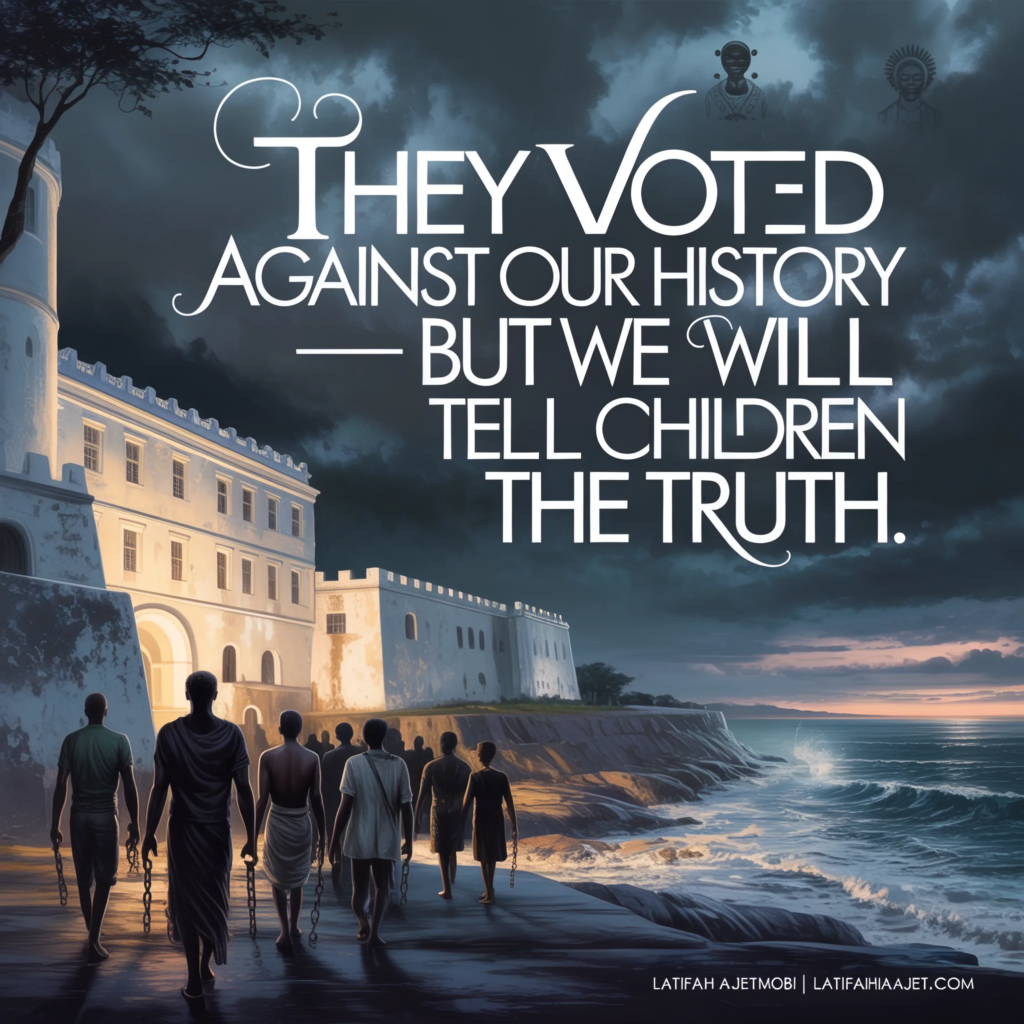
A Historic Vote the World Needs to Know About
On the 25th of March 2026, something historic happened at the United Nations.
It was the International Day of Remembrance of the Victims of Slavery and the Transatlantic Slave Trade. And on that day, the world voted.
The UN General Assembly adopted a resolution spearheaded by Ghana. It declared the transatlantic slave trade the gravest crime against humanity. It received 123 votes in favour. Only three countries voted against — Argentina, Israel and the United States. UN News
The United Kingdom and all 27 members of the European Union abstained. Al Jazeera
In other words, they chose silence.
One hundred and twenty-three nations looked history in the face and chose truth. However, three voted no. And fifty-two — including the UK, where many of us are raising our children — said nothing.
As a parent, a coach, a Nigerian woman, and a daughter of Africa, I refuse to be silent. And I am writing this because you must not be silent either — especially with your teenagers.
Why Our Children’s Identity Depends on This
In my coaching work with teens, I see one wound more than any other. It is identity confusion.
Young people from African and Caribbean backgrounds are growing up unsure of who they are. They do not know where they come from. Many feel ashamed of their heritage instead of proud of it.
This is not accidental.
At the UN commemorations, a speaker said something powerful. She said: “Slavery was merely an interruption. It was never our origin story.”
She was right. History did not forget Africa’s centuries of royalty, kingdoms, and dynasties. It simply stole the pen and edited us out.
When we do not tell our children their true history, we leave a vacuum. And vacuums do not stay empty. They get filled — with colonial narratives, with shame, and with lies about who our people are.
That is why this moment matters. Not just politically. But for your teenager, sitting in their bedroom right now, trying to figure out who they are.
What the UN Resolution Actually Said
The language of this resolution is important. Therefore, let us look at it clearly.
The resolution unequivocally condemns the trafficking of enslaved Africans and racialized chattel enslavement as the most inhumane and enduring injustice against humanity. NBC News
It calls on UN member nations to engage in talks on reparatory justice. This includes a full and formal apology, measures of restitution, compensation, rehabilitation, and guarantees of non-repetition. NBC News
Furthermore, the resolution urges the prompt and unhindered restitution of cultural items — including artworks, monuments, museum pieces, documents and national archives — to their countries of origin without charge. NBC News
Ghana’s foreign minister Samuel Ablakwa said it clearly: “History does not disappear when ignored. Truth does not weaken when delayed. Crime does not rot. And justice does not expire with time.” Al Jazeera
These are not just words. They are a demand. And our children need to hear them.
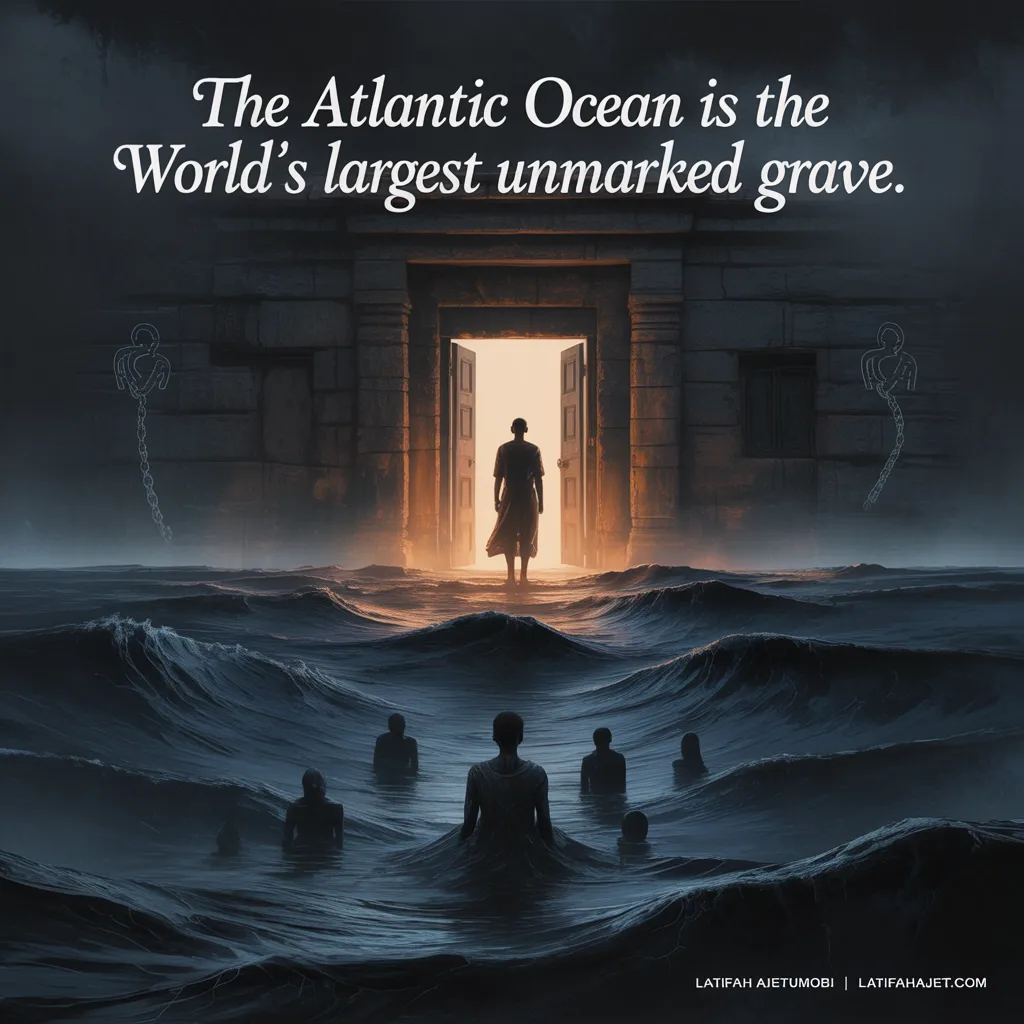
The Atlantic Ocean: The World’s Largest Unmarked Grave
This is the part schools rarely teach. But our children must know it.
We speak of 12.5 million Africans being taken. However, that is only who survived to disembark. The crossing — known as the Middle Passage — was a journey of unimaginable horror.
Trafficked Africans were forced to lie chained and manacled for weeks. They could not stretch out or stand except during limited time on deck. The conditions were a breeding ground for disease. Some captives suffocated from the lack of air below deck. On some ships, the mortality rate was as high as 33%. Equal Justice Initiative
African women and girls faced additional horrors. They were forced to be naked and separated from the men. They lived in constant fear of rape and assault by the crew. Equal Justice Initiative
In total, about 15% of kidnapped Africans — nearly two million people — died during the Middle Passage alone. Equal Justice Initiative
Nearly two million human beings. Dead. In the ocean. Some were thrown overboard. Others jumped by their own choice. Some refused to eat. Others organised insurrections, though few succeeded against the overwhelming force of the crew. Encyclopedia Virginia
And that was only the crossing. Another 15 to 30 percent died during the march to the coast or during confinement before boarding. For every 100 slaves who reached the New World, another 40 had died in Africa or during the journey. Digital History
The Atlantic Ocean is, in truth, a mass grave. It has never been properly mourned, marked, or acknowledged by the nations that created it.
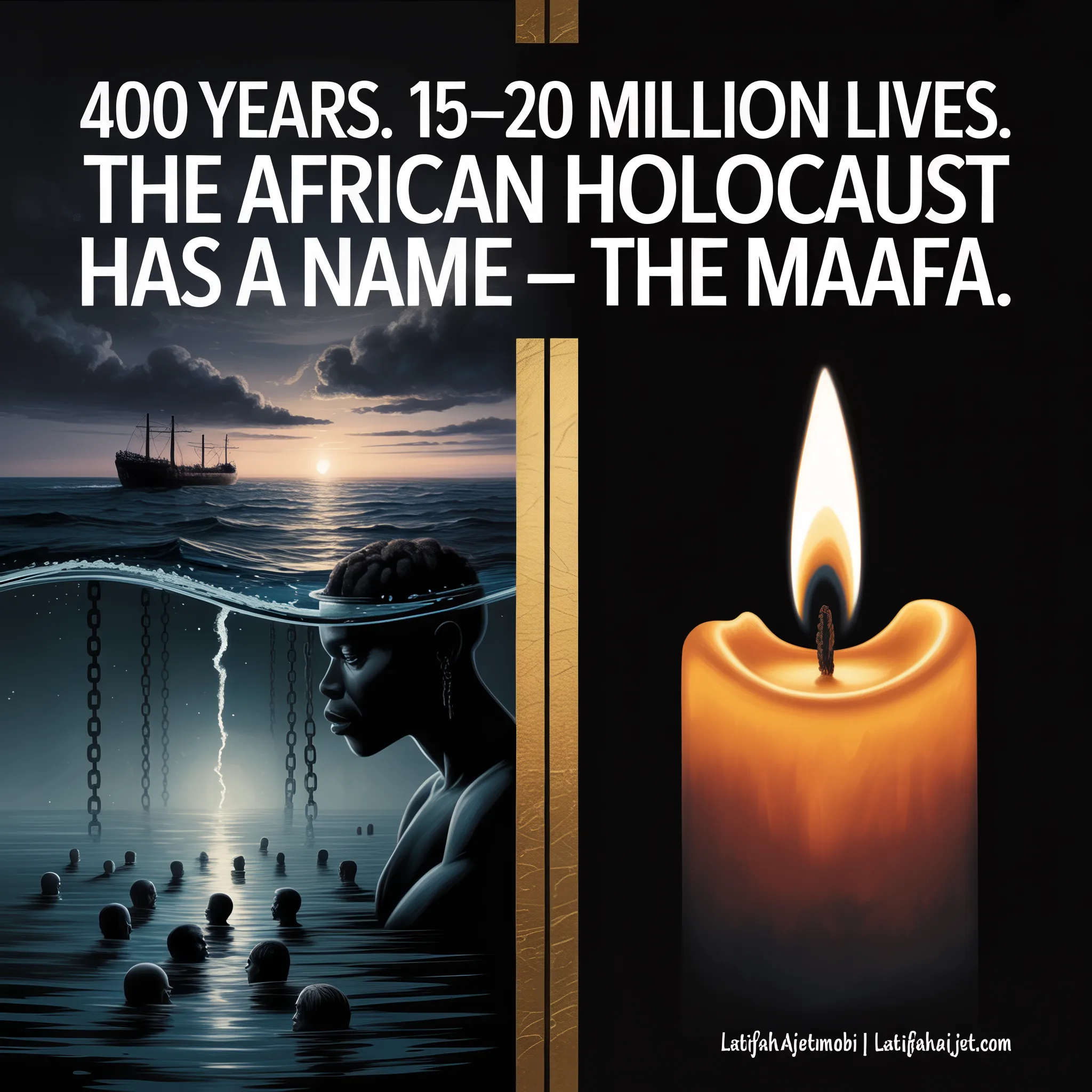
The Maafa: Africa’s Holocaust
We speak of the Holocaust often — and rightly so. The systematic murder of six million Jewish people by Nazi Germany is one of the most documented and commemorated atrocities in modern history. The world built museums. It passed laws. It said: never again.
Yet there is another Holocaust that lasted not six years — but four hundred.
Canadian scholar Adam Jones characterised the mass death of Africans in the slave trade as genocide. He described it as “one of the worst holocausts in human history.” He estimated it resulted in 15 to 20 million deaths. Wikipedia
Jones wrote: “A reasonable estimate of the deaths caused by this institution is fifteen to twenty million people — by any standard, one of the worst holocausts in human history.” Quo Vademus
Some African scholars prefer a different word. They use the Swahili term Maafa — meaning Great Disaster. The term Maafa serves much the same purpose for Africans as the word Holocaust serves for Jewish communities — to name a culturally distinct experience of genocide. Wikipedia
This is not a competition in suffering. Every genocide is a tragedy beyond measure. However, our children must understand the scale of what happened to African people. It was not simply “slavery.” It was a centuries-long, globally organised system of mass abduction, torture, death, and cultural destruction.
Never before had millions of people been kidnapped and trafficked over such a great distance. The permanent displacement of 12.5 million Africans to a foreign land, with no possibility of returning, created an enduring legacy that shapes our world today. Equal Justice Initiative
The Holocaust ended in 1945. The consequences of the Maafa — systemic racism, stolen wealth, and broken cultural identity — are still being lived by our children today.
Where Our Stolen Artefacts Are Right Now
Our bodies were not the only things taken. Our culture was stolen too.
An estimated 90 to 95 percent of Africa’s cultural heritage is held outside the continent, according to a 2018 report commissioned by French President Emmanuel Macron. Foreign Policy
Here is where some of our most important treasures currently sit:
🇬🇧 The British Museum, London — holds at least 73,000 objects from sub-Saharan Africa. These include the Benin Bronzes and the carved ivory pendant mask of Queen Idia. Foreign Policy
🇫🇷 Musée du Quai Branly, Paris — France holds 90,000 African artefacts. Most were taken during colonial rule. Foreign Policy
🇧🇪 Royal Museum for Central Africa, Belgium — holds more than 120,000 artefacts. Most were taken from the Belgian Congo during King Leopold II’s brutal regime. Foreign Policy
🇩🇪 Humboldt Forum, Berlin — holds around 75,000 African artefacts, including objects looted during colonial military expeditions. Foreign Policy
🇺🇸 The Smithsonian, Washington DC — In 2022, the Smithsonian formally transferred ownership of twenty-nine Benin Bronzes to Nigeria. Cambridge Core However, legal disputes continue.
Think about that. If your child wants to see the art of their ancestors — the crowns, the bronzes, the royal masks — they may need to travel to Europe to find them. That is the reality. And it must be spoken aloud.
Museums Your Family Can Visit
These are not just tourist sites. They are acts of remembrance. Consider visiting them as a family — as an intentional educational pilgrimage.
🌍 Africa
Cape Coast Castle — Ghana Visitors can walk through the slave dungeons, condemned cells, auction halls and the Door of No Return — the exit through which millions of Africans were marched onto ships, never to return home. Slavery and Remembrance To stand in those dungeons is to feel history with your whole body.
Maison des Esclaves — Gorée Island, Senegal This former slave house sits on a small island off Dakar. The Door of No Return looks directly out onto the Atlantic Ocean. Presidents and millions of visitors have stood here in solemn remembrance.
🇬🇧 United Kingdom
International Slavery Museum — Liverpool Liverpool was one of the largest slave-trading ports in history. This museum holds one of Europe’s most comprehensive collections of slavery-related artefacts.
Royal Museums Greenwich — London This museum explores the role of British maritime power in enabling and profiting from the slave trade across centuries.
🇺🇸 United States
National Museum of African American History and Culture — Washington DC The “Slavery and Freedom” exhibition explores the history of the transatlantic slave trade and the Middle Passage, with powerful objects including ballast stones from confirmed slave shipwrecks. Smithsonian Institution
EJI Legacy Museum — Montgomery, Alabama Features over 200 sculptures by Ghanaian sculptor Kwame Akoto-Bamfo, memorialising those who died during the Middle Passage. Equal Justice Initiative
🌐 Online
slavevoyages.org — a searchable global archive of individual slave ship voyages, routes, and African regions of origin. Sit with your teenager and search together. The data is there. The truth is there.
The Reparations Question: Where Things Stand
The African Union is currently working to create a unified vision among its 55 member states about what reparations for slavery should look like. The UN resolution urges member states to engage in dialogue on reparations. This includes formal apologies, returning stolen artefacts, financial compensation, and guarantees of non-repetition. Al Jazeera
So far, progress has been slow. The Netherlands remains the only European country to have issued a formal apology for its role in slavery. Al Jazeera Britain has not. France has not. Belgium has not.
The resolution is not legally binding. However, it carries significant political weight. It potentially creates a broader definition of crimes against humanity in international law and allows for restitution claims against perpetrators. The Conversation
Our children’s generation will be the ones to push this across the finish line. But only if we equip them with the truth.
What You Can Do As a Parent — Starting Today
You do not need to be a historian to have this conversation. You just need to start it.
1. Start the conversation today. Simply say: “Did you know the UN just voted to call the slave trade the gravest crime against humanity? Let me tell you what that means.” That is enough to begin.
2. Name the death toll honestly. Nearly 2 million people died in the Atlantic Ocean alone. The total death toll across the entire system reached an estimated 15 to 20 million. Your child deserves to know the full weight of what happened.
3. Introduce the word Maafa. Give your child the African-centred language to name what happened to our people. It was not just “slavery.” It was the Great Disaster. And it has a name.
4. Visit a museum together. Whether it is the International Slavery Museum in Liverpool or Cape Coast Castle on your next trip to Ghana — choose remembrance over avoidance.
5. Teach them to question the narrative. When school textbooks give the slave trade two paragraphs, your child needs to ask: “Is this the full story? Whose voice is missing?”
6. Read together. My book, Beyond the Goat Pen: An African Woman’s Journey, is one woman’s story. But it is also Africa’s story — of resilience, identity, and the refusal to be erased.
A Final Word
Ghana’s President John Dramani Mahama said before the vote: “Let it be recorded that when history beckoned, we did what was right for the memory of the millions who suffered the indignity of slavery.” UN News
Millions of our ancestors did not survive the Atlantic. They died in chains, in the dark, in water. They never got to hold their children again.
We are still here. And we hold the pen now.
Do not let someone else write our children’s story.
Latifah Ajetunmobi is a certified Parent, Teen & Life Coach, registered nurse and midwife, and author of Beyond the Goat Pen: An African Woman’s Journey and The Phone-Free Teenager. She is passionate about equipping African diaspora families to raise confident, culturally grounded young people.