
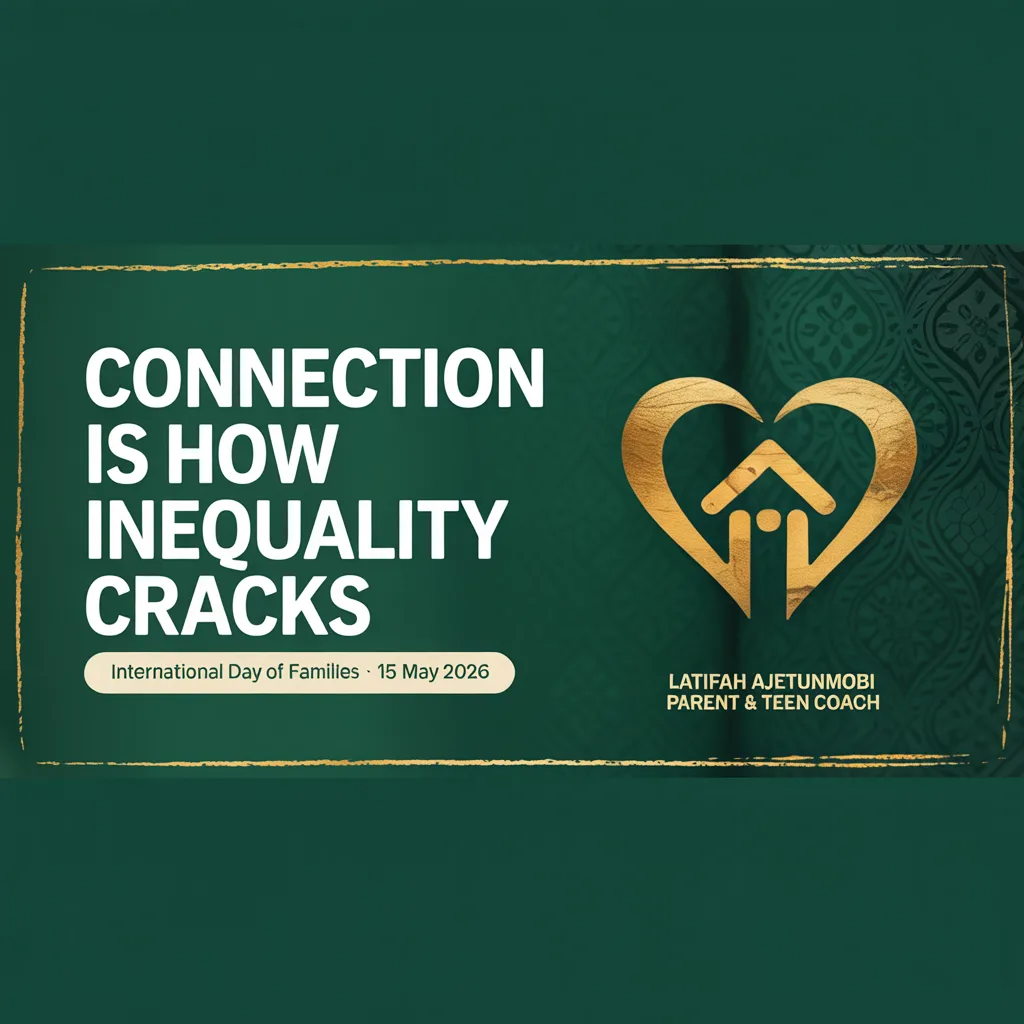
Every 15th of May since 1994, the world pauses to mark the International Day of Families. It is not a day of cake and balloons. It is a day of reckoning — a moment to ask honestly how the smallest unit of our societies, the family, is faring under the weight of a fast-moving world.
In 2026, the United Nations has chosen the theme “Families, Inequalities, and Child Well-Being.” As a parent and teen coach, a registered nurse, midwife and mental health nurse, and a woman whose first home was a compound between Yola and Port Harcourt, I cannot think of a more urgent conversation for this moment.
What the UN means by inequality — and what it misses
The UN frame is necessary and right. Across the world, children are growing up under widening gaps in income, healthcare, housing, schooling and digital access. A child born in one postcode in London has a measurably different life expectancy than a child born three stops down the Tube line. A child in rural Nigeria still walks miles for water her cousin in Lagos turns on with a tap. A teenager in a high-income household may have unlimited internet but no parental supervision, while another has neither device nor data.
These inequalities are real, and they shape lifelong outcomes. Family-oriented policy—parental leave, child benefits, accessible childcare, and digital inclusion—matters. I will always advocate for it.
But there is a quieter inequality that policy cannot reach on its own. It lives inside our front doors.
The inequality of attention
In my coaching practice I meet families from every income bracket. And I have seen a pattern that defies economics: a child can be materially well-resourced and yet emotionally impoverished. A teenager can have the latest phone and the loneliest evenings. A widow can live in a beautiful house and still be invisible at the dining table.
This is the inequality of attention. The inequality of being heard. The inequality of belonging.
It cuts across class, culture, and continent. And it is the inequality that families themselves have the power to address this week, without waiting for any government white paper.
Three places this shows up in modern families:
The first is the screen time gap between parent and child. We hand teenagers devices we do not understand and then scold them for living inside those devices. In The Phone-Free Teenager, I argue that the answer is not surveillance but presence—adults who put their own phones down first.
The second is the silent grief of widowed women and orphaned children, particularly in diaspora and African contexts. Beyond the Goat Pen was my attempt to make this visible. When a woman loses her husband, she should not also have to lose her home, her voice, and her standing among her own people. Yet across many cultures, including some of ours, she does.
The third is the generational rift in migrant families. Children raised abroad and parents shaped by another country can live under one roof and yet inhabit two different worlds. Without intentional bridge-building, that gap hardens into estrangement.
In every case, child well-being suffers. Because well-being is not only the absence of harm. It is the presence of connection.
The Communication Cascade Model™: Connect, Understand, Thrive
The framework I teach is simple, but it is not easy.
Connect first. Before correction, before lecture, before consequence — connection. A child who feels emotionally safe will tell you things you would never extract by interrogation.
Understand second. Behavior is information. The eye-rolling teenager, the withdrawn ten-year-old, the suddenly quiet auntie—each is communicating. The work of the adult is to listen for what is underneath.
Thrive last. Thriving is the harvest, not the starting line. Children, teenagers, and elders thrive in the soil of connection and understanding. Skip those two, and you can throw every resource in the world at a family and still watch it wilt.
What you can do this week
I want to leave you with three small commitments for the week of 15 May 2026:
Audit the attention in your home. Whose voice is heard least? Whose feelings are most often dismissed or “managed”? That person is your invitation.
Schedule a five-minute floor. Sit on the floor — or the sofa, or the kitchen step — with one child or teenager for five undistracted minutes. No phone. No agenda. Just presence. Repeat daily.
Reach beyond the front door. Family is wider than the household. Call the widowed aunt. Message the cousin in the diaspora who has gone quiet. Take a meal to the single mother on your street. Inequality cracks where communities show up.
A final word
The International Day of Families is not just a day for the United Nations. It is a day for you, for me, for every kitchen table where a small human is waiting to be truly seen.
Policy will do its slow, important work. But the gap we can close today — the gap between an adult and a child in the same room — is the one that shapes everything else.
Connect. Understand. Thrive.
That is how families heal. That is how children flourish. That is how a society becomes, at last, a little more equal.
Latifah Ajetunmobi is a certified parent and teen coach, registered nurse, midwife and mental health nurse, and founder of The Latifah Ajetunmobi LLC. She is the author of The Phone-Free Teenager and Beyond the Goat Pen: An African Woman’s Journey. Connect with her at latifahajet.com.