
In late 2010, a New York Times reporter named Nick Bilton was on the phone with Steve Jobs. Jobs had called to complain about something Bilton had written. Trying to change the subject, Bilton asked what seemed like a safe question: your children must love the iPad?
Jobs told him they hadn’t used it. The family limited how much technology the children used at home.
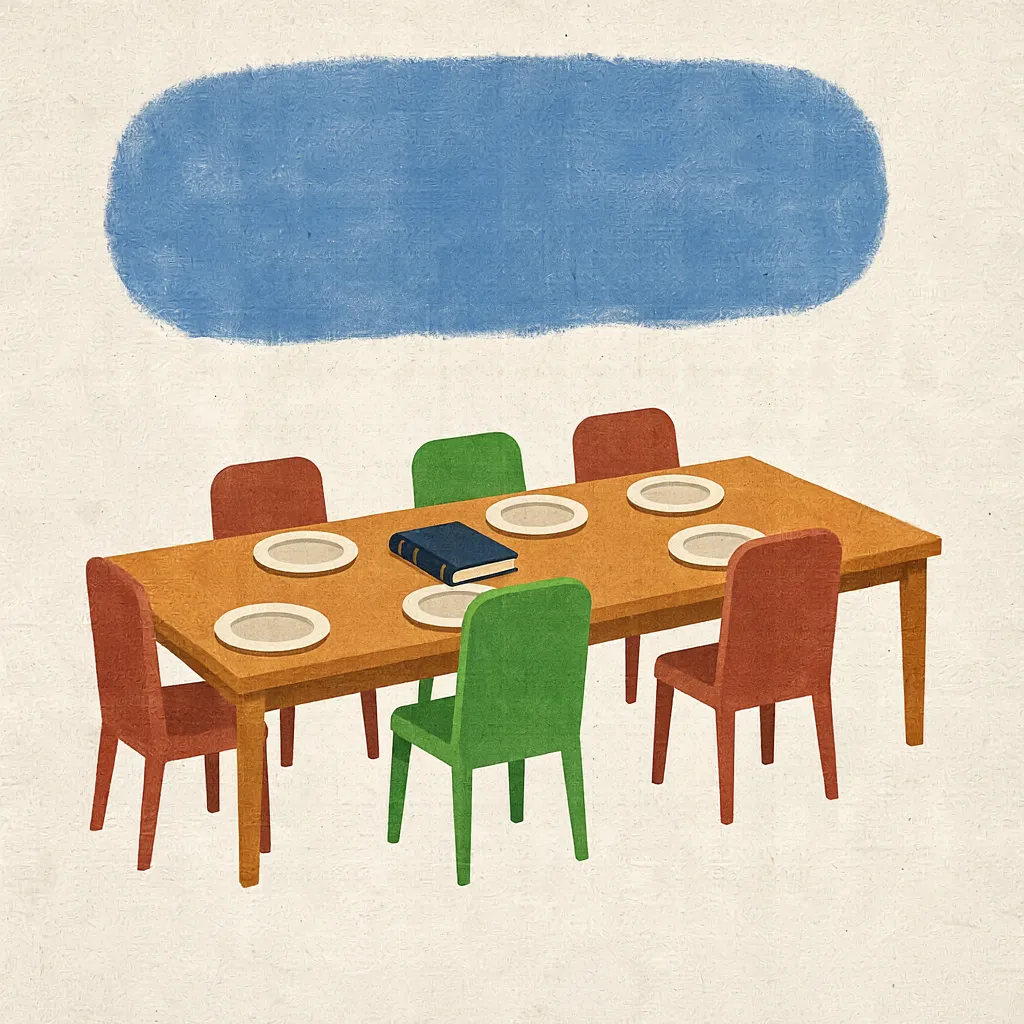
Bilton held that exchange for four years before publishing it, in a 2014 column titled “Steve Jobs Was a Low-Tech Parent.” Walter Isaacson, who spent long stretches in the Jobs household writing the biography, confirmed the picture: dinner every evening at the long kitchen table, conversations about books and history, nobody reaching for a device.
The man who put the glass rectangle in a billion hands did not put one in his children’s.
He is not the exception. He is the pattern.
The pattern
Bill Gates did not allow his children their own phones until they turned fourteen. No phones at the table during meals. His children complained, he has said, that other children got theirs earlier.
Sundar Pichai, chief executive of Google, has said he did not give his eleven-year-old a phone. Shou Zi Chew, chief executive of TikTok, has said his own children are not on TikTok. Evan Spiegel of Snap limited his seven-year-old to ninety minutes of screen technology a week. Chris Anderson, the former editor of Wired, put time limits and parental controls on every device in his house — because, he explained, he had seen the dangers of the technology firsthand.
And a few miles from the headquarters of Google and Meta sits the Waldorf School of the Peninsula, where fees run past thirty-five thousand dollars a year and children do not use screens in the classroom until seventh or eighth grade. Silicon Valley families fill the seats.
Ask yourself a simple question. If a product is good for children, why do the people who understand it best keep it away from their own?

What is actually happening in the brain?
For a long time, this was just an interesting anecdote. Now there is evidence.
In 2025, researchers at MIT’s Media Lab published a study with an unsettling title: Your Brain on ChatGPT: Accumulation of Cognitive Debt. Fifty-four participants wrote essays under three conditions with an AI assistant, with a search engine, or with nothing but their own mind. They wore EEG headsets throughout.
The finding was consistent. Brain connectivity scaled down in direct proportion to how much external help the person had. The unaided group showed the strongest, widest-ranging neural networks. The search engine group was in the middle. The AI group showed the weakest connectivity of all.
Then came the detail that should stop every parent cold. When researchers asked participants to quote from the essay they had written minutes earlier, the AI group struggled. They could not reliably recall their own work. They also reported the lowest sense that the essay belonged to them.
The researchers named this cognitive debt. The work looks finished. The thinking was never done. And like any debt, it comes due later.
There was one hopeful finding, and it matters enormously for how we teach our children. In a later session, participants who had started with their own thinking and then brought AI in afterwards showed stronger memory and re-engaged brain regions. Those who had leaned on AI from the start and were then asked to work unaided showed weaker engagement.
The order is not a detail. The order is the whole lesson.
The confidence trap
A second study, from Microsoft Research and Carnegie Mellon, surveyed 319 working professionals about 936 real tasks they had completed with AI. It found something that sounds obvious once you hear it and is devastating once you apply it to a fifteen-year-old.
The more confidence a person had in the AI, the less critical thinking they did. The more confidence a person had in their own ability, the more critical thinking they did.
The researchers put it plainly: people often stop thinking critically precisely when they lack the skill to inspect and improve what the machine gives them.
Now hold that beside a child. A child does not yet have the expertise to judge whether an answer is good. A child has nothing to check the machine against. So the child accepts. Every time.
We are handing the most powerful answer-generating tool in history to the people least equipped to interrogate it and calling it access.
The generational number
In January 2026, the neuroscientist and education researcher Jared Cooney Horvath testified before a United States Senate committee that Generation Z appears to be the first generation in modern history to score lower than the generation before it across attention, memory, literacy, numeracy and general reasoning.
For most of the last century the opposite was true. Average scores rose steadily, roughly three points a decade—the Flynn effect, named for the psychologist James Flynn. Each generation arrived a little sharper than the one before. Better nutrition, better schooling, and more complex environments.
That line has flattened, and in several countries it has bent downward. International assessments show the same shape: declines in reading, mathematics, and science across many wealthy countries, beginning in the mid-2000s and steepening after 2010.
Researchers disagree about how much of this is caused by technology specifically, and honest people should say so. Test norms change. Populations change. Correlation is not proof.
But note what nobody disputes: the rise stopped. And it stopped in the decade the screen entered the child’s pocket.
Denmark has already begun pulling screens back out of primary classrooms in favour of hands-on and play-based learning. Sweden reversed course on classroom tablets. These are not superstitious countries. They are countries that looked at their own data.
Why I am not telling you to ban anything
I work in data. SQL, Power BI, Snowflake, Tableau. I use these tools every working day and I am not romantic about the past. My children will live in a world where AI is ordinary, and a child who cannot use it will be shut out of rooms I want them inside.
That is exactly why I am careful.
A tool is only a tool in the hands of somebody who could do the job without it. A calculator in the hands of a mathematician is leverage. A calculator in the hands of a child who never learned to add is a life sentence.
The question was never whether our children use AI. The question is what must already be built in the child before the tool is handed over — and in what order.
That is what this two-week series is about. Next week I will lay out the framework I use with the parents I coach: what to build first, when to introduce the tool, and the three questions that decide it.
For now, one thing to sit with.
The builders sent their own children to schools without screens. They were not being sentimental. They were reading their own product roadmap.
Latifah Ajetunmobi is a certified parent and teen coach, a registered nurse and midwife, and the author of The Phone-Free Teenager and Beyond the Goat Pen. She works with parents raising teenagers across the world.